

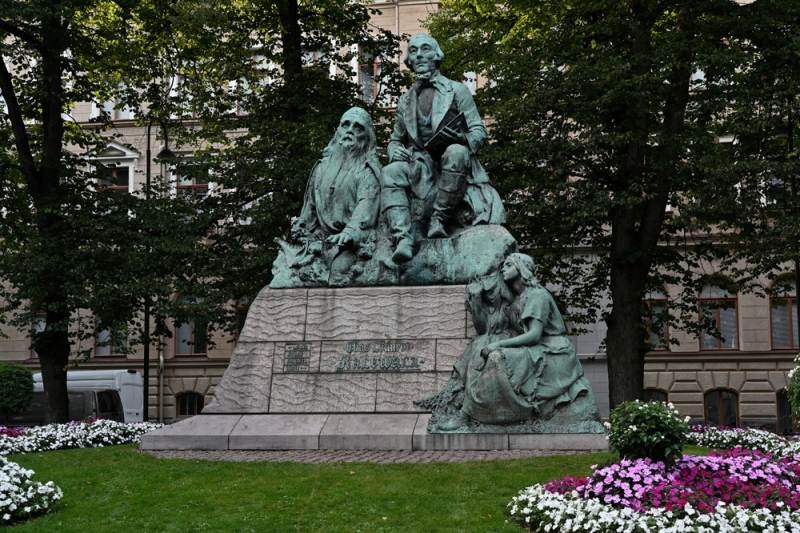
Finnish mythology provides an interesting insight into the way people formerly thought about nature, magic, life, and death. Way before it was ever written, Finnish fairy tales were carried from parent to child and generation to generation through spoken word, rhyme, song, and stories.
All of these traditions were later related to the famous Kalevala, giving this mythology a historic literary context.
Finnish mythology was transmitted mainly orally and not in one ancient religious publication. Through generations, they told stories and passed them down in the form of rhythmic songs and poetry that aided in their memorization. Their stories conveyed a familiar everyday life with the forest, lake, animals, farming, weather, death, and the seasons.
The written tradition of Finnish mythology gained significance when Elias Lönnrot gathered traditional songs of Finland and Karelia. He compiled these songs into the Kalevala, published for the first time in 1835, with a second edition published in 1849. His collection ensured that the most essential parts of the Finnish folklore remained preserved and the Kalevala mythology became generally known.
The Kalevala heroes and heroines are larger than life, their stories filled with magic, music, craft, feud, and adventure. They are not necessarily good or evil; they might be geniuses or fools, brave or weak, but they are always human.
These are just a few of the most familiar characters. They are Vinminen, the wise singer whose songs had magic powers; Ilmarinen, the legendary blacksmith who forged fabulous objects; and the Sampo itself, the fabulous object built by Ilmarinen. Lemminkinen, the reckless and daring hero, whose tales describe a voyage to Tuonela, the land of the dead; these make Finnish myths unique.
Nature is at the core of many Finnish gods and mythology. Rather than placing the main emphasis on warrior gods, Finnish mythology has a lot more to do with supernatural beings and nature, lakes, forests, creatures, storms, hunting, and everything else in the environment. Some important figures include:
These numbers reveal just how eager the ancient mythology of Finland was to depict nature as wild and strange. The nature-lore of Finnish tales was uniquely characterized by a strong bond between the supernatural creatures and the world around us.
In Finnish folklore, there are many supernatural creatures that can have a positive or negative role and can be at times dangerous, sometimes elusively linked to certain areas. All these creatures reveal how the former inhabitants used oral narration to explore the unknown and scary environment. Some notable examples include:
They bring a little of the mystery back to Finnish folklore and demonstrate how intertwined the worlds of the supernatural were with the daily life of forests, animals, water, and so forth.
The Sampo is considered one of the most significant items in the Kalevala. You will notice that the specifics of its nature are never entirely clarified; this just adds to the mystique of the narrative. Typically, you'll find it described as some mystical object of prosperity; it's often associated with wealth, food, or plenty. The story involves several major characters:
When they try to take the Sampo back, they end up in a huge fight, and the object breaks into pieces. It is one of the most famous stories of Finnish mythology, as it contains magic, greed, violence, and suspense.
Finnish folklore has long been fascinated with the Northern Lights and whether they could have magical qualities. One popular legend makes them out to be a fiery fox racing across the snow. Its tail is said to have left sparks in the sky.
In Finnish, "revontulet" translates to "fox fires," and this is the term most often used today. In other northern cultures, the lights have been attributed to spirits, magic, or other supernatural elements. These other cultures show how magical tales originating from Finnish mythology can turn awe-inspiring natural phenomena into wonderful stories.
Finnish mythology is distinct from Norse mythology, despite the fact that Finland is close by. When reading about Finnish gods and myths, you need to make this distinction; the characters, mythic stories, and oral traditions are separate.
Norse mythology is characterized, for example, by the names Odin, Thor, and Loki, but in Finnish tradition the highlights are bigger, associated with Vainamoinen, Ilmarinen, Louhi, fairies, songs, and the wilderness. So the Finnish tradition is not the same as a Scandinavian version of mythology.
Ancient Finnish mythology still has significance, as it offers a reflection of the thoughts and imagination of ancient people. The ways in which ancient narratives attempted to explain nature, relations, risk, death, fortune, and the unknown before the current model of explanation.
It is also present in the arts and in literature, music, and fantasy. Many writers, including J.R.R. Tolkien, have borrowed from the Kalevala.
And for readers of today, stories from Finnish mythology have served as more than ancient tales. They show how storytelling maintained a culture's customs and identity.
Finnish mythology weaves Finnish music, magic beings, elements of nature, mighty gods, fantastic creatures, and mythical adventures. From Vinnimen to Ilmarinen to the Sampo and the stories of the magic lights in the sky, Finnish mythology is unique and inspired by forests, water, weather, and all kinds of inspiration.
Learn about the Kalevala and why Finnish gods and myths keep influencing the arts.
The oldest sources of Finnish mythology were primarily oral traditions that existed before these myths were compiled in written form. People passed beliefs and stories through songs, poetry, rituals, and storytelling, so there is no specific date when Finnish mythology began.
Elias Lönnrot assembled the Kalevala. He did not create the traditional stories himself but gathered and arranged older oral poems and songs from Finnish and Karelian sources into the epic work known today.
Yes. An iconic example from the Kalevala describes the formation of the world through Ilmatar, a spirit of the air, and a bird that lays eggs. The fragments of the eggshells become the sun, moon, earth, and sky.
Tuonela is a legendary realm in Finnish mythology associated with the dead. It is described as a distant and difficult-to-reach place separated from the world of the living. Several Finnish mythology stories feature heroes venturing into this mysterious realm.
The Kalevala made traditional oral poetry an element of written literature and enabled it to be "captured" in everlasting words. Stories were preserved in this way for generations and could not be tampered with over the centuries. It became part of Finnish self-awareness and fiction.
This content was created by AI